A supplier cannot price or design an industrial panel correctly from motor horsepower alone. Before you approve a quotation, you need to test the design basis, ratings, documentation, heat management, software scope and acceptance process. The questions below give you a practical checklist for the supplier meeting, quotation comparison and purchase order.
Key takeaways
- Send load schedules, motor data, drawings and site conditions before design.
- Require ratings, standards, enclosure details and exclusions in the quotation.
- Compare every line for components, testing, software, commissioning and warranty.
- Demand evidence for heat control, power quality, safety functions and acceptance tests.
What technical information must you send before the supplier designs the panel?
Send the supplier a complete design basis before requesting a firm quotation. Include:
- A single-line diagram, connected load, maximum demand, motor list, motor ratings, starting methods, voltage, frequency, phase arrangement, available fault current and transformer data.
- The control philosophy, sequence description, emergency-stop requirements, interlocks, communication protocols, instrument list and the required number and type of spare I/O points.
- The enclosure location, available installation space, cable-entry direction, ambient temperature, altitude, humidity, dust, condensation, washdown chemicals, corrosive vapours, UV exposure and hazardous-area classification.
- Whether the panel is indoors, outdoors, in a control room or near the process.
State the heat-load basis, including VFDs, transformers, power supplies, contactors and harmonic filters, and request the resulting internal temperature and derating assumptions. Ask for NEMA Type 1, 3R, 4, 4X or 12, or the required IP rating; the label alone does not describe every exposure.
| Arrangement | Use it when | Separate it when |
|---|---|---|
| PLC, MCC and VFD | Controls, starters and drives share a suitable duty | Heat, maintenance access or process location conflicts |
| PCC and APFC | Incoming distribution and correction fit the fault level | Fault level, heat or segregation demands isolation |
Reject a standard arrangement when a mixer, pump or conveyor needs different starting method compatibility, overload class, safety function or environmental enclosure. Require the supplier to identify design assumptions and missing inputs that could change price or equipment selection.
Which electrical ratings, standards and construction details must appear in the offer?
Your offer must print the rated operational voltage, insulation voltage, frequency, busbar current, incoming and outgoing feeder ratings, motor-starter ratings, and breaking capacity for every protective device.
| Item | Require in the offer | Why it matters |
|---|---|---|
| Assembly rating | Marked short-circuit current rating (SCCR), available fault current, and calculation basis | The SCCR must exceed the installation fault level |
| Protection basis | Exact upstream fuse or circuit-breaker type, rating and coordination assumption | Changing a specified fuse can invalidate the documented SCCR |
| Construction | IP rating or NEMA Type 1, 3R, 4, 4X or 12; separation form; busbar material and dimensions | An enclosure designation alone does not define every environmental requirement |
The main disconnect rating does not establish the short-circuit rating of the complete panel. Ask whether the design is a tested assembly or a site-built arrangement, then require the supporting test records, drawings and modification controls.
For an IEC 61439 assembly, ask which design-verification method covers:
- Temperature rise and short-circuit withstand
- Clearances, creepage and dielectric properties
- Protective-circuit continuity
A component certificate does not prove that the completed assembly passed every required verification. Request IEC 60947 compliance for switching and protective devices, plus enclosure steel thickness, gland-plate details, wiring identification, protective-earth connections and door-bonding provisions. Confirm that the quotation includes cable glands and compliance labels, not only the metal enclosure.
How should you compare the quotation line by line?
A low quotation price often comes from omitted equipment, downgraded components or unspecified substitutes. Require a bill of materials that names the manufacturer, exact part number, series or revision, electrical rating, country-of-origin constraint, approved substitute and obsolescence status.
- Compare the main breaker, fuses, contactors, overload relays, PLC CPU and modules, HMI, VFDs, meters, protection relays, control transformers, 24 VDC power supplies, network switches and safety devices by model.
- Reject descriptions such as “PLC module” or “24 VDC power supply”; they conceal differences in diagnostics, inrush capacity, hold-up time, environmental limits and certification.
- State spare capacity by type: spare digital inputs and outputs, analog inputs and outputs, safety channels and network ports.
| Item | Line-by-line evidence |
|---|---|
| I/O | Point-to-point list with terminal numbers, wire numbers, signal type, normal state, fail state, voltage, shielding, grounding, and originating and terminating drawings |
| Included equipment | Cable glands, field junction boxes, motor disconnects, fans, filters, air conditioning, network switches, software licences, programming, commissioning and spare parts |
| Commercial boundary | Each item marked supplier-supplied, customer-supplied or excluded |
Put the boundary of supply in the purchase order. A drawing must not show a field junction box or network switch that the quotation assigns to another party.
Assess Maxwell Tech Solutions Pvt Ltd against this same line-item evidence, not a general reliability claim. Require revised drawings and prices whenever a model, substitute or quantity changes.
Related products
 | Electrical Control Panel Manufacturer in India, Pune, Pimpri Chinchwad | Maxwell Tech Solutions Pvt. Ltd. Maxwell Tech Solutions Pvt. View product → |
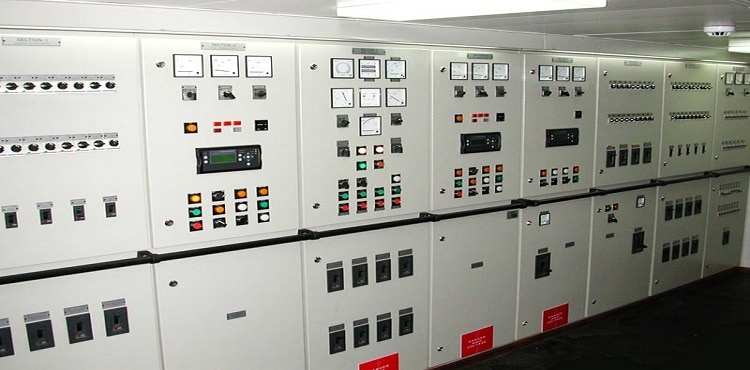 | Electrical Control Panel Manufacturer in India, Pune, Pimpri Chinchwad | Maxwell Tech Solutions Pvt. Ltd. Maxwell Tech Solutions Pvt. View product → |
How will the supplier control heat, environment and power quality?
A panel rated for 25 °C can overheat at 40–50 °C, trip drives or shorten capacitor life. Ask the supplier to prove thermal performance for the actual site, not a room-temperature catalogue condition.
- Require a heat-load calculation at the specified ambient temperature and altitude. Include VFDs, transformers, power supplies, contactors, harmonic filters and other losses; then state the resulting internal temperature, component derating and cooling method. The answer may be natural cooling, a fan-filter arrangement, forced ventilation, air conditioning or different components.
- Confirm the operating temperature limits and derating curves for PLCs, drives, capacitors and capacitor banks. Ask what alarm or trip occurs if the enclosure temperature exceeds those limits.
- Specify the environmental requirement as NEMA Type 1, 3R, 4, 4X or 12, or by an IP rating. Do not treat one designation as a substitute for the complete specification: state exposure to washdown chemicals, dust, condensation, corrosive vapours, UV and hazardous areas.
NEMA Type 4X adds corrosion resistance, but it does not define every IP characteristic.
- Ask how several drives, switching power supplies or welders will affect input-current distortion, neutral conductors, transformers, generators and APFC equipment. Require expected total harmonic distortion, line-reactor, passive-filter or active-filter scope, and the interaction with power-factor correction.
A displacement power factor near 1 does not prove low harmonic distortion. Insist on measured or calculated values at the stated operating load.
What must the supplier prove about drives, controls, safety, software and acceptance?
A drive selection is incomplete without the motor-cable and fault-behaviour evidence behind it. A mixer rated only by horsepower can stall on a settled batch, overheat its motor or exceed gearbox torque before the nominal speed is reached.
1. For each VFD, request motor data, VFD cable length and type, output-reactor or dV/dt-filter requirement, motor-insulation suitability, carrier frequency, bearing-current mitigation and overload capacity. For each mixer, require the torque-speed envelope based on batch volume, density, viscosity, solids loading, impeller geometry, shaft speed, settled-product starting condition and allowable acceleration time.
2. Require a written control philosophy for voltage restoration, emergency stop, network loss, instrument-air loss, overload and a stalled mixer. Define each actuator’s safe state; make auto-restart an explicit decision, not an accidental drive parameter.
3. Request the I/O list. For every safety function, obtain the performance level or SIL, risk-assessment assumptions, architecture, diagnostic coverage, proof-test interval and validation report.
4. Make the FAT procedure part of the purchase order. The approved script must test power-up and power-loss behaviour, I/O simulation, permissives, interlocks, alarm latching and reset, analog scaling, sequence timing, safety functions, communications loss, drive trips and representative batch cycles. Record measured results and open exceptions.
5. Demand editable software files for PLC, HMI, drives and motion, plus version identifiers, passwords or ownership terms, licences, firmware versions, network addresses, parameter backups and a restore procedure. Document managed switches, segmentation, time synchronisation, remote access and failure behaviour for EtherNet/IP, PROFINET, Modbus TCP and OPC UA.
Frequently asked questions
What technical information must you send before the supplier designs the panel?
Send the load schedule, motor list, voltage and fault level, control philosophy, single-line diagram, I/O list, enclosure location, ambient conditions and required drawings.
Which electrical ratings and construction details belong in the offer?
The offer should state system voltage, frequency, short-circuit withstand rating, main and feeder ratings, enclosure IP rating, dimensions, material, busbar details, standards and component makes.
How should you compare electrical control panel quotations?
Use a line-by-line comparison that checks quantities, component ratings, manufacturers, exclusions, drawings, testing, software, installation, commissioning, delivery and warranty.
How should a supplier control heat, environment and power quality?
Ask for the heat-load calculation, ventilation or air-conditioning method, enclosure protection, corrosion provisions, harmonic mitigation, surge protection and earthing design.
What proof should the supplier provide for drives, controls, safety and acceptance?
Request drive sizing, PLC and HMI architecture, safety-circuit details, software backup, FAT procedures, test records, as-built drawings, manuals and site acceptance criteria.
Related products
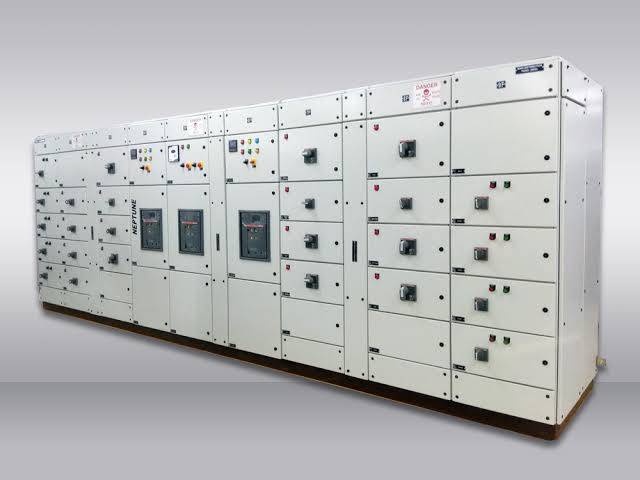 | Electrical Control Panel Manufacturer in India, Pune, Pimpri Chinchwad | Maxwell Tech Solutions Pvt. Ltd. Maxwell Tech Solutions Pvt. Ltd. View product → |
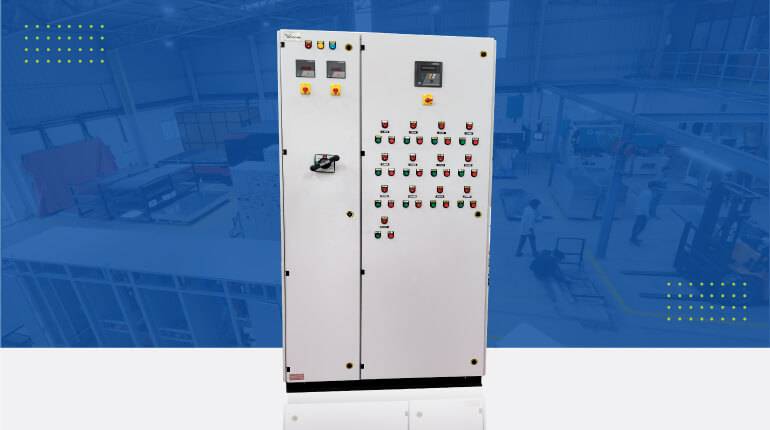 | Electric Panel Automatic Power Factor Correction Apfc Panel ₹120000 APFC Control Panel Manufacturer in Pune | Talawade Power Factor Panel Experts Looking for a trusted APFC Control Panel manufacturer in Pune and... View product → |
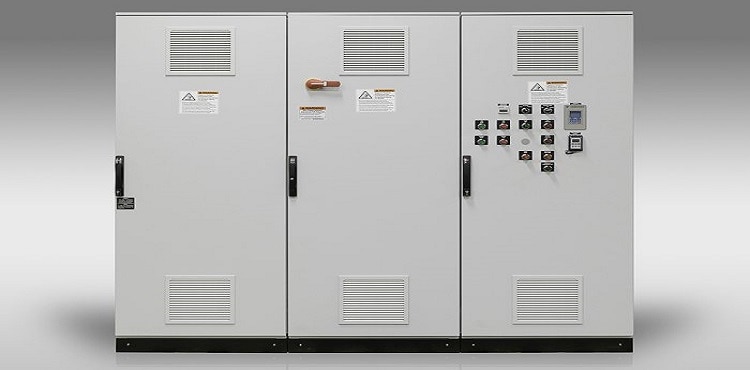 | Electrical Control Panel Manufacturer in India, Pune, Pimpri Chinchwad | Maxwell Tech Solutions Pvt. Ltd. Maxwell Tech Solutions Pvt. View product → |