The right machine depends on the formulation, the dispersion endpoint and the way the vessel will operate—not on motor horsepower or maximum rpm alone. By the end, you will have a specification for comparing manufacturers, testing competing designs and rejecting equipment that cannot handle your actual batch conditions.
Key takeaways
- Define viscosity, solids loading, batch volume and dispersion targets before requesting quotes.
- Compare loaded operating performance, not empty-vessel rpm claims.
- Specify rotor, vessel, shaft, lift and vacuum requirements for your batch.
- Require documented trials, safety features, maintenance access and service commitments.
Define the process before you request a quotation
Give the manufacturer a process definition, not merely a nominal batch size. High speed disperser selection depends on how the product behaves during charging, wetting and dispersion, because an empty-vessel rpm claim does not predict loaded production performance.
1. State the batch size, minimum and maximum working volume, required throughput and vessel dimensions. Request a validated operating range; at low fill, the blade can lose submergence and pull a deep vortex, while high fill can restrict circulation and overload the motor.
2. Describe viscosity and solids loading at operating temperature, including yield stress, particle size, target particle size and whether viscosity increases during processing. Ask for a test using your formulation or a representative rheological surrogate, since advertised maximum viscosity is not portable between products.
3. Define the duty and endpoint: powder incorporation, wetting, deagglomeration or true dispersion; dispersion time; sampling method; and the acceptance limit for particle size, uniformity or fineness.
4. Provide operating conditions, including temperature range, pressure or vacuum requirement, charging sequence and whether the blade remains fully wetted. Include the solvent, hazardous ingredients and any cleaning constraints.
5. Ask the manufacturer to size the shaft, hub, blade, bearings, motor and drive from loaded torque, not nameplate horsepower alone. Request continuous and peak torque curves, minimum stable speed, acceleration time, overload duration and torque during charging and viscosity growth.
6. For scale-up, provide the pilot data and demand comparisons for tip speed, power per unit volume, blade-to-vessel ratio, geometry and residence time. Matching rpm alone can produce a different dispersion result.
Require a defined trial or factory acceptance test that records loaded current or torque, speed stability, vibration, leakage, interlocks and the agreed dispersion endpoint. That evidence turns a quotation into a defensible specification.
Match the machine to the actual mixing duty
A high-speed disperser is the right technology when your formulation needs rapid wetting, particle breakup and uniform distribution in a liquid. It is not the default choice for every mixing duty: dispersion versus blending determines whether high shear is necessary or merely adds heat, power consumption and air.
| Mixing duty | Better starting technology | Decision test |
|---|---|---|
| Simple blending | Anchor, paddle or ribbon blender | Do ingredients only need uniform distribution? |
| Dispersion and deagglomeration | High-speed disperser | Must pigments, fillers or powders be wetted and broken apart? |
| Homogenization or emulsification | Rotor-stator homogenizer | Do you need fine droplets or a narrow particle-size distribution? |
| Very high-viscosity mixing | Planetary mixer | Does the product resist flow and require wall-scraping action? |
| Final particle-size reduction | Bead mill | Will a disperser leave particles above the specified target? |
A deagglomeration machine comparison should use actual solids loading, yield stress, temperature and particle-size targets rather than advertised maximum viscosity. Ask for a test using your formulation or a representative rheological surrogate.
Compare tip speed, not rpm alone: U = πDN, with D as blade diameter and N as revolutions per second. Also require loaded torque data; an empty vessel reaching rated speed proves little. If vortexing entrains air, specify a cover, anti-vortex geometry, vacuum capability or a low-speed sweep anchor, along with the required air-content limit.
Check rotor, vessel and scale-up specifications
A production-ready disperser is defined by rotor geometry, usable torque and vessel proportions—not motor rpm alone. Use the tip speed formula U = πDN, where D is blade diameter in metres and N is revolutions per second. Two machines at 1,500 rpm can create different shear when their blade diameters differ.
Check the diameter-to-tank ratio, blade clearance, immersion depth and working volume together.
Request these specifications in writing:
- Blade diameter, profile, number of blades, shaft speed range and calculated tip-speed range. Include the minimum speed that remains stable without surging or settling.
- Tank diameter, straight-side height, working-volume range, bottom shape, baffle arrangement and blade-to-bottom clearance. A rotor that performs in a narrow test vessel can dead-zone a wide production tank.
- Motor continuous and peak torque curves, torque during charging, allowable overload duration, thermal limits and power per unit volume. Nameplate horsepower alone will not predict whether the shaft stalls as viscosity rises.
- Drive details for a variable frequency drive disperser: constant-torque rating, controlled acceleration, low-speed overload capacity, braking and repeated-cycle thermal protection.
- Shaft and hub calculations for torsional and bending loads, including off-centre loading, startup shock and high-viscosity operation.
| Scale-up check | Match between vessels | Consequence when ignored |
|---|---|---|
| Tip speed | U, not rpm alone | Different shear and particle breakup |
| Power density | Motor power per working volume | Slower dispersion or stalled loading |
| Geometry | Diameter-to-tank ratio, clearance and fill height | Dead zones, vortexing or poor wetting |
| Batch timing | Dispersion time and residence time | A passing lab batch misses production throughput |
Choose the shaft, lift and vacuum arrangement for your batch
Choose a fixed shaft for repeatable batches in one dedicated vessel; choose hydraulic lift when one machine must serve vessels of different heights or allow unobstructed tank access. The fixed shaft versus lift-mounted shaft decision concerns flexibility, cleaning access and blade positioning, not shear quality alone.
| Option | What it means | When it applies |
|---|---|---|
| Fixed shaft | Blade stays at a set elevation | Dedicated vessel, stable batch geometry and straightforward production |
| Hydraulic lift | Shaft and blade move vertically | Multiple vessels, variable fill levels, easier charging and cleaning |
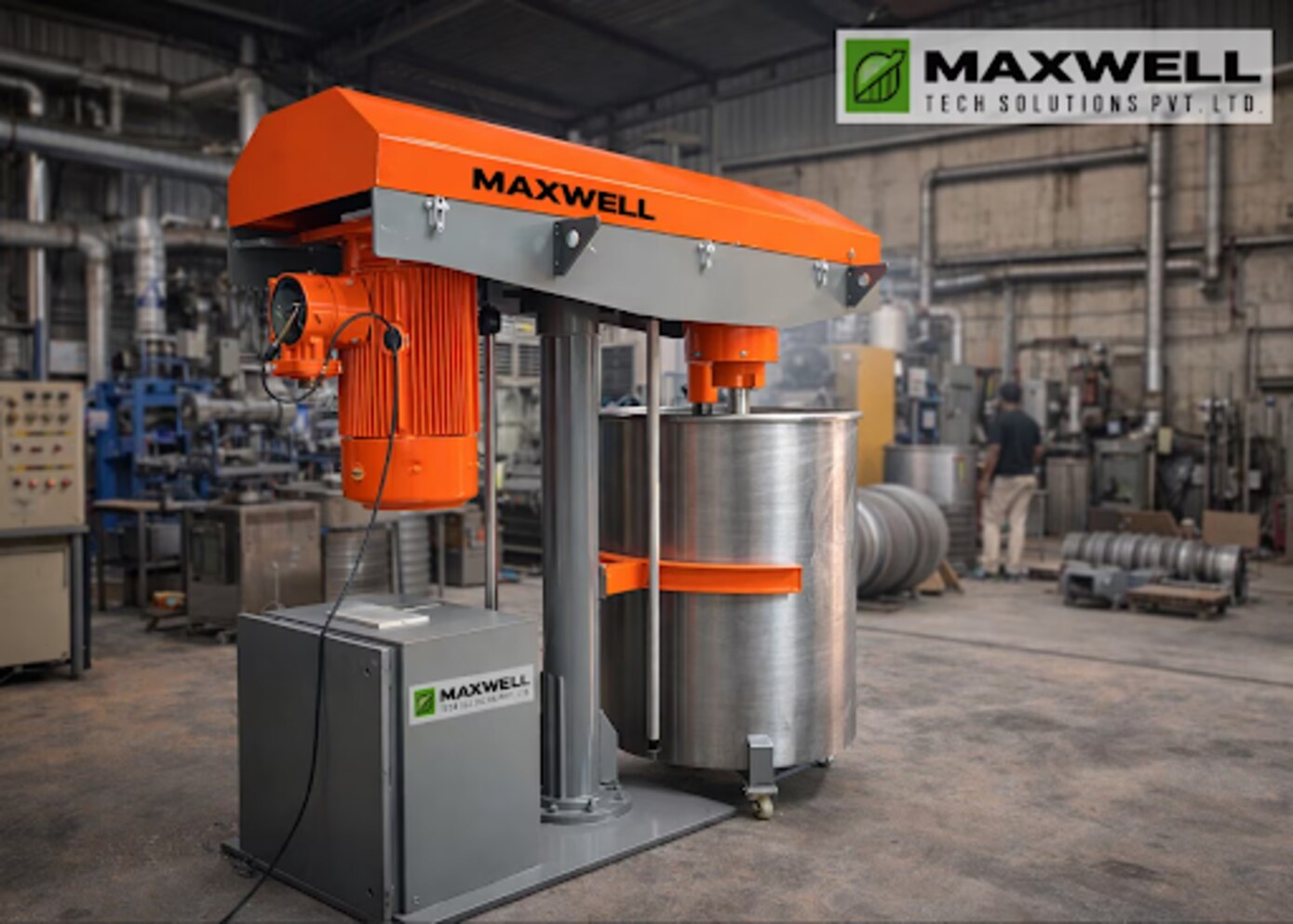
| Dual shaft | High-speed disperser plus slow-speed anchor or sweep | High-viscosity products, heavy solids, or formulations needing surface-to-bottom circulation |
| Closed vacuum | Sealed vessel with controlled vacuum and suitable shaft seal | Air-sensitive products, solvent retention, foaming control or a specified air-content limit |
Select a dual-shaft mixer when the dispersing blade alone cannot circulate the batch. A slow sweep anchor prevents stagnant zones while the high-speed blade breaks agglomerates; it also helps at high viscosity and high solids loading.
Choose a vacuum disperser when bubbles, oxidation or solvent loss would fail the product specification. A cover alone does not remove entrained air: specify the vacuum level, seal arrangement, condenser requirement and pressure rating. Confirm that the vessel remains sealed during lifting and that the recipe includes a controlled deaeration stage.
Vortexing can pull air into the batch, especially at low fill or excessive tip speed. Add anti-vortex geometry or a low-speed sweep, then validate air content at the minimum and maximum working volumes.
Make the manufacturer prove performance, safety and serviceability
Require witnessed evidence from a production-representative trial, not a brochure or an unloaded speed demonstration. A factory acceptance test should use your formulation, batch size, sampling method and acceptance limit, then record:
1. Dispersion endpoint, batch temperature, speed stability and acceleration time. The report should also show vibration, seal leakage and temperature rise; otherwise a machine can pass in the workshop and fail during continuous production.
2. A loaded torque test covering charging, rising viscosity and the final operating point. Request continuous and peak torque curves, minimum stable speed, allowable overload duration, drive type and braking method. Motor horsepower alone does not prove usable capacity.
3. Machine safety interlocks for guard or cover closure, vessel position, minimum liquid level, drive health, seal or cooling health and restart prevention. Require the safety circuit diagram and validation evidence for the specified Performance Level. An emergency stop must not depend only on a normal PLC stop command.
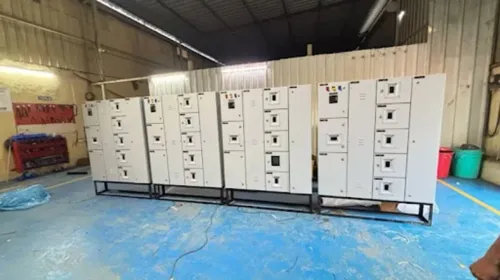
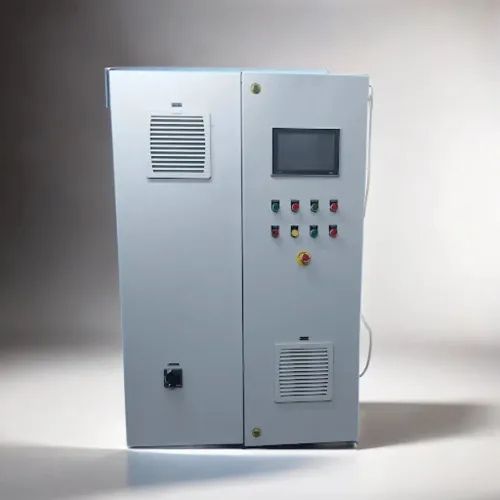
4. Industrial control panel integration that exposes permissives, alarms, trends and fault history. Restrict and audit bypasses, and confirm the variable-frequency drive has constant-torque capability, controlled acceleration, low-speed overload capacity and thermal protection.
5. Service documents: certified drawings, wiring diagrams, spare-parts references, lubrication instructions, seal-replacement steps and a clear commissioning and response process. Maxwell Tech Solutions Pvt Ltd should be evaluated against this same evidence checklist, not the breadth of its catalogue.
Related product
 | High Speed Disperser ₹560000 Manufacturer in India, Pune, Pimpri Chinchwad A High Speed Disperser is an essential industrial mixing machine designed for efficient dispersion,... View product → |
Frequently asked questions
What process information should you provide before requesting a high speed disperser quotation?
Provide the product’s viscosity range, solids loading, particle or agglomerate size, batch volume, charging sequence, dispersion target, temperature limits and required cycle time.
How do you match a high speed disperser to the mixing duty?
Match the machine to the product’s flow behaviour, viscosity, solids content, wetting sequence and required dispersion quality rather than choosing by nominal vessel size or maximum rpm.
Which machine specifications should you compare between manufacturers?
Compare rotor diameter and tip speed, vessel working volume, shaft configuration, motor rating, usable speed range, scale-up basis and the manufacturer’s loaded performance data.
When do you need a vacuum arrangement on a high speed disperser?
Specify vacuum when the process requires deaeration, controlled solvent handling, reduced evaporation or processing under a defined pressure. Confirm vessel sealing, vacuum rating and safe operation.
How can a manufacturer prove that its disperser is suitable?
Request a witnessed trial or representative test report covering ingredients, batch size, rotor, speed, temperature, cycle time, final dispersion result, safety controls and serviceable components.